
What follows is the historic background to provide the context for this piece. Instead, you might want to skip to my creative response.
Thanks to Dan Brown (The Da Vinci Code) and the Tom Hanks film many of us are now very aware of the Knight’s Templar. Some would have been aware of the historical context of this order – a service protecting those travelling on pilgrimages to the holy lands around Jerusalem. Not only were they an order of warrior monks – but also early bankers and quickly becoming very powerful and influential.
Their funding didn’t come from nowhere – they relied on both their banking but also other enterprises such as Preceptory farms around Europe – they had 57 such establishments in England including one on what was on an estate known as Temple Newsam today.
Timeline
Anglo Saxon rule
Neu husum (‘New Houses’ – now Newsam) wasn’t especially old when William defeated Harold at Hastings and took charge of England. The thanes who had ownership were Dunstan of Swillington and Gluniairnn. At this time Newsam was will part of the Viking Skyrack of Yorkshire (based in Headingley). They both lost many of their lands post conquest – Ansfrid the Dane took ownership of Neusum (along with 30 other places in England)
The Harrying of the North
When William first conquered England not everyone fell into line and, as a result of disruptive behaviour, he instructed his men to ensure those causing trouble fall into line (or went away). This happened in 1068/9 and resulted in what must have been the single most destructive activity to occur in England. Many people were killed outright, others starved due to destruction of homes, crops and animals. It is thought around 5% of England died and three-quarters of those caught up permanently left their lands; in what we would today refer to as a form of genocide.
We know of the impact due to the Domesday Book – as it led to the taxable value of the Newsam estate to fall to a tenth (10%) of it’s 1066 values by 1089. It was noted that, over a hundred years later when the Templars took over, it had still not recovered from the ‘scorched earth’ policy.
By the time of the Domesday Book Ilbert De Lacy had become tenant-in-chief. He, in turn, was banished and lost the lands when he sided against Henry I.
The creation of the Templar Preceptory
Many god-fearing landowners chose to give lands to the Templars to support their activities. The knights would use these to create farming (and other) enterprises to enable them to support those travelling to Palestine.
Initially they were gifted Newsam – it was still damaged following the harrying a century before. Eventually this included the manor of Whitkirk. The Templars were given these by William de Villiars (and confirmed by the Tenant-in-Chief – Lord D’Arcy) – but papers recently sold at auction confirmed that the estate had many other plots of land around the area and further into what is now West Yorkshire donated to the Order.
In 1300 the Newsam preceptory played host to Edward II en route to a battle in Scotland.
The end of the Templars
In 1191 Acre* fell, essentially marking the end of the Crusades. Less than 25 years later the Templars were themselves toppled.
On Friday 13th 1307 Philip IV of France had all the Templars in his lands arrested; essentially this was because they had become so powerful and rich and the king didn’t like this – so what are believed to be trumped up of inflated charges were levelled at them.
In France many met gruesome ends and by 1312 the Pope has dissolved the order – with the Knight’s Hospitallers taking over many former Templar insitutions.
Edward II had married Philip’s daughter only a couple of years earlier and had pressure placed on him to also end the Templars in England. It’s suspected this wasn’t his preference given he’d been happy to stay at Newsam only years before but being swayed by the older (and more powerful) monarch. He had many English Templars arrested and imprisoned in 1311; though most were thought to be treated well. Godfrey des Arches was the final preceptor (leader) of Templar Newsam.
He reclaimed the Templar premises – many were when transferred to the Hospitallers. But Newsam was instead given to Sir Robert Holland who was first made a baron (reportedly in relation to the Templars prior to their demise), pardoned for his part in the death of Piers Gaveston (thought by many, including Christopher Marlowe, to be Edward’s lover) and eventually fell out of favour with the King, who then reclaimed Newsam.
Philip and Edward didn’t last much longer – Philip died in 1314 and Edward lasted a little longer but was replaced by his son in 1327 and died shortly after – considered by many to be murdered.
It’s also related to the story that Edward’s son – another Edward (also known as the Black Prince) started the 100 Year’s War due to the wool trade only 20 years after the English Templars ceased to be. The statue of the Black Prince in Leeds’ City Square is entirely unrelated.
*Acre is near Haifa in current day Isreal.
Ongoing influence
The Preceptory continued to be farmed within the broader estate; eventually becoming Temple Thorpe Farm. This was lost to opencast mining in the twentieth century.
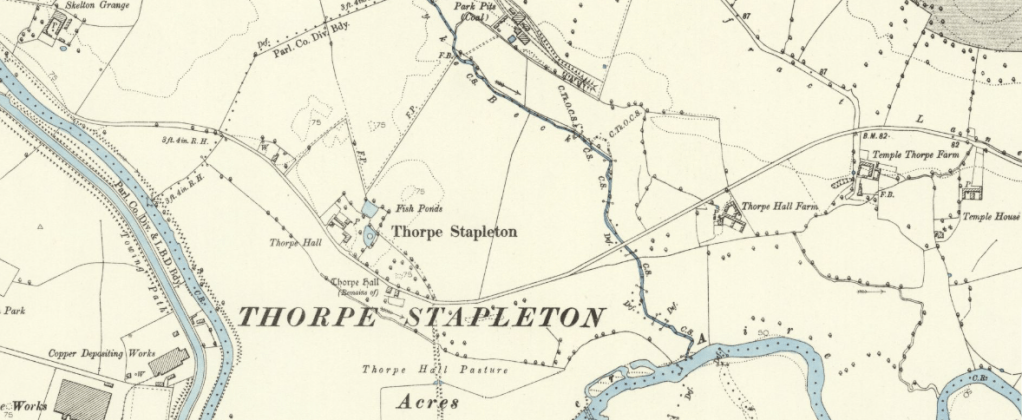
1891 map of the area showing Temple Thorpe farm (centre,right) Templars would often indicate buildings under their protection – in this area this was often subsequently with a two-barred cross. It seems like some of the tax privileges of the Templars continued after their demise – which led to crosses still being on some buildings even now.
Templar buildings weren’t limited to the estate – buildings on and around Briggate and Eastgate showed a Templar cross – including (until quite recently) on the Park Horse pub.
Many streets and buildings both around the estate and within Leeds include references. It’s assumed this was based on the Templars founding a coaching inn on Briggate.
The final reference is that Newsam is referenced in Ivanhoe (Walter Scott, 1819) as Temple Stowe – with the templars cast in the villain role. A (somewhat camp) clock tableau in Leeds’ Thornton’s Arcade contains moving characters from this story (1877/8)

Where was the preceptory?
Archeological digs at either end of the 20th century found various remains of what would have been mainly timber structures at the preceptory (most funds left the local area to fund crusade activities).But they did find both evidence of a 50m barn and stone burial caskets for former Knights.
It is generally felt that the Preceptory was on land now part of Skelton Lake Nature Reserve (next to a motorway service area of the same name)
There is some questioning if part of the current Jacobean mansion of Temple Newsam we know today (over the motorway and up the hill from Skelton Lake) is formed of remains from templar days. This isn’t lacking in possibility – especially as the manor of Whitkirk (post-conquest) was assigned to the Templars
What happened at the preceptory
They farmed the land, returning it to use following the harrying and were relatively successful with this property. It achieved a value of £93 17s 2d at it’s final assessment – including over a thousand sheep as well as almost 60 ploughing beasts and 3 mills – including what was one of the first English fulling mills. It’s worth keeping in mind that they would have to grow all the feed for animals as well as themselves; but they would also have tenants who they were claim tithes (taxes) from.
Furthermore – the Pope had declared that Templars (and those on their lands) were exempt from local taxes and could, instead, raise their own taxes – including from milling activity.
My understanding is that the Templars were exporting some of their high quality wool to Europe – either Flanders (Northern Belgium) and/or Lille and Arras in Northern France – to be turned into cloth. This is part of Leeds’ long history of who was edward iiiexport textile trade.
Other names
The Templar’s were also known as The Order of Solomon’s Temple and by their latin name Pauperes commilitones Christi Templique Salomonici (The Poor Fellow-Soldiers of Christ and of the Temple of Solomon).
 Jon Eland