

When I started the project which quickly became Along the Calls I hadn’t really thought about how it would tie in with my desire to know myself and my place in the world better; I knew I’d be able to link this in but I didn’t know how it would work or come about. Scurry forwards many months and, despite a lot of procrastination, the project is now starting to take shape – in my head at least.
Talking to the past..?
The interesting point I’m finding now is that I’m really engaged with not only how I ‘converse’ with (or better understand) my theoretical historic predecessor but also the stuff around that – how our lives differ, how they’re the same, what their context was – can I hope to empathise with it?
Can I hope to understand the situation or mental state of someone living a lifestyle that is predominantly subsistence when mine has so many elements which are purely there to make my life better. This is even more pointed by the fact I’m whiting this on a laptop which was purchased mainly to support my hobbies and sat in a garden which is mostly there to be somewhere pleasant for me to sit.
Seeking to understand
I’m aware that my predecessor would be not only growing his own food but also repairing his own home, making his own clothes and doing all this without any significant chance of changing his position in life.
A conversation with a friend recently made me think about how this person might exist – he wasn’t able to read – but there were many books anyway. He had an enforced day off – essentially to attend church. Would he have concerns for better himself?
How much did they worry about the laws – both those of the land (set by their lord) and those of the spiritual?
Past research tells me that medieval English peasants were often deeply concerned with obeying the rules of the Church. The Church played a central role in everyday life and had a significant influence over society. Peasants were taught to fear divine punishment and were regularly reminded of the importance of obeying Church laws. This obedience was not just out of fear, but also due to a genuine belief in the spiritual and moral codes prescribed by the Church.
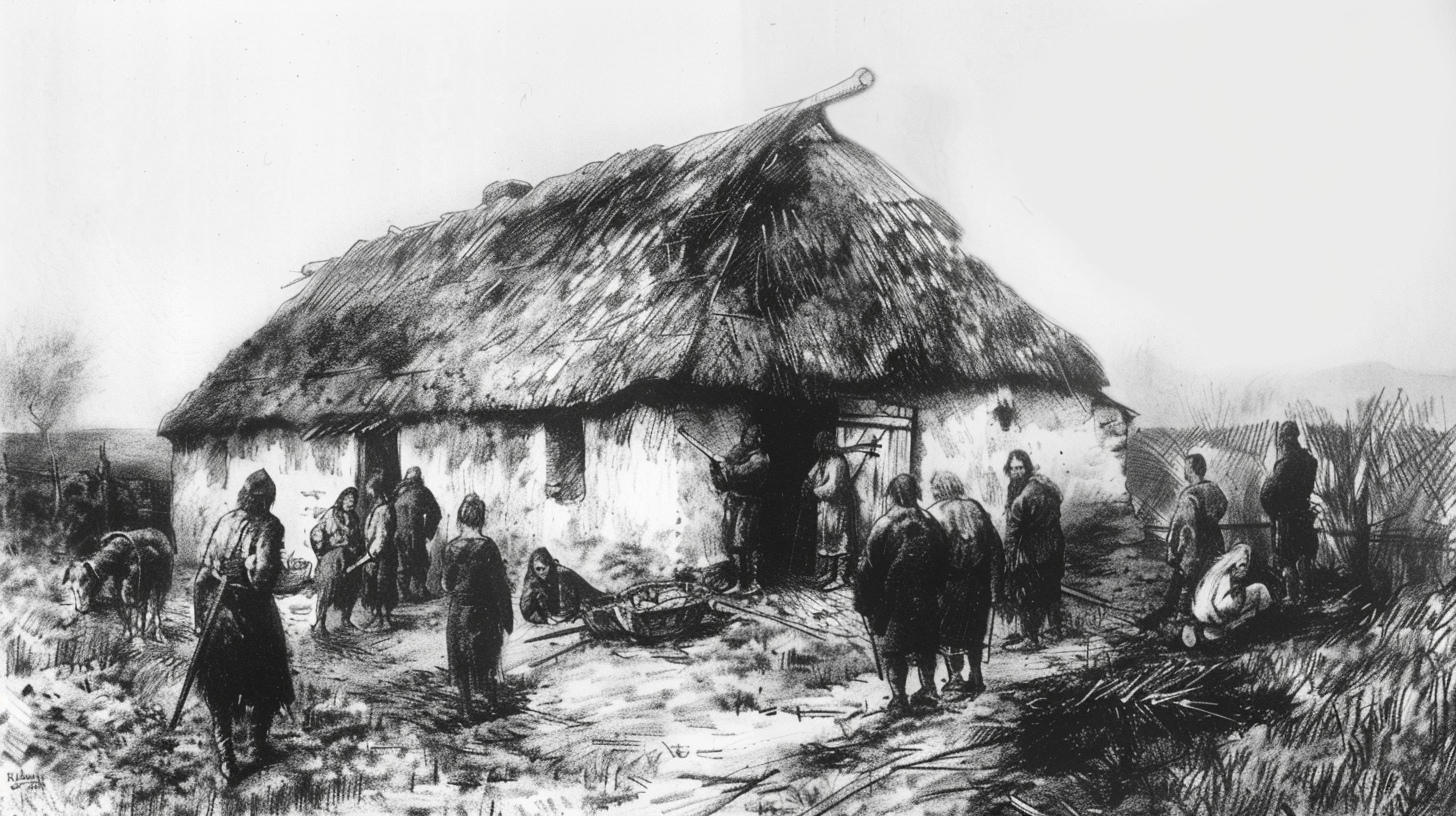
At the same time I find it hard to believe they didn’t have time for socialising and cameraderie – that they didn’t entertain each other, that parents didn’t tell children tales that weren’t just moralising. They lived in larger communities – a longhouse household would often be formed of several generations – ten or more to a single dwelling.
Things changed so slowly compared to now – a hundred years or more would go by without a significant scientific advancement and families would continue to follow a similar position in a locale for many generations. In addition pre-occupations were hyper local, people rarely left their village and then often just to visit those in adjacent villages and hamlets. News, when it arrived, was often quite historic.
Significant changes came about mainly with the arrival of new peoples – the anglo-saxons (who filled the void the Roman empire collapsed) brought new technologies and a new language. Through Roman times it’s assumed folk living in Yorkshire spoke a Brythonic branch of Celtic. The Vikings and Normans changed how society was run – but not day to day language – but the only long term impacts of the Vikings were on place names (and genetics).
My interest in the point in time following the Conquest is due to the significant long-reaching change; the impact on many aspects of everyday life – a swing towards patriarchy with a focus very much on the leader.
In the North of England this change of rule was felt very differently to the south. Lords aligned to the Vikings failed to fall in with William the Conqueror and sought to outright reject his rule. His response was incredibly harsh – the harrying of the North. Village after village not only attacked – but the way of living utterly destroyed (cattle killed, grain stores burned, villages set alight) – leading to a period where those that survived the attacks often then struggled (and died).
Leeds avoided this fate – my current research (1) suggests it had been in Viking hands in 1066 and the ruling thegns didn’t return once William took control. Whether they died at the battles of Stamford Bridge or Hastings, somewhere else or simply knew better than return the lands were immediately re-distributed by William (to Ilbert de Lacy) rather than this happening after the uprisings and suppression a couple of years later.
Ilbert didn’t retain Leeds – it had little value (politically or economically) so he passed it to fellow Norman Ralph Paynel who, in turn, bought his way into heaven by giving away the tax rights (both those due to the lord and the church) (2) to the newly formed Holy Trinity priory (3) – essentially an off-shoot of a Norman monastery from Caen
These factors led to the inhabitants of Leeds being treated quite differently to many elsewhere in the area (and indeed country). In the times to follow this led to many in Leeds having the time to develop specialisms – often in wool and clothmaking. But my interest is in how this would have impacted the residents in the immediate aftermath:
- How much impact would a change of ruler have had?
- What did they think of the harrying of other settlements?
- Did they understand why they escaped it? Teachings often suggested that what befell someone was because of how they behaved. Would the citizens of Leeds be shocked by the behaviour of William’s men – or would they believe that the other settlements must have been bad people?
- What would the indirect impact of the harrying have been on them – would they have taken people in from settlements nearby who had been harried?
- How existential would all this seem to them – or would day to day subsistence outweigh any worries of the broader world?
I’m very interested in any thoughts you have on this – please don’t hesitate to comment or contact me directly (either via email or on instagram)
References and notes
This post is not rigourously validated. It forms part of a creative project which seeks to better understand what the day to day life of past inhabitants of Leeds might have thought and experieinced. I welcome suggestions of improvements (or other avenues of consideration/research).
(1) A history of Kirkgate from earliest times to 1800 – Steven Burt and Kevin Grady, 2016
(2) Ralph Paynel wasn’t short of land – as you can see in the Domesday wiki he was Tenant in Chief or Lord of around 100 places. However Leeds’ income wasn’t small – I’ve read references which suggested it contributed about 50% of the income of the priory at one point.
(3) After the dissolusion of the monasteries by Henry VIII the church of Holy Trinity continued to be used by the parish – now known as Holy Trinity, Micklegate.
Side note: My reading suggests both anglo saxon and viking rule was won by skill (eg on a battlefield) – it was with William the Conqueror that diving right started to be established.

 Jon Eland